How to Break Out of “Harold & Kumar” Mode and Use Investment Banking Information Sessions to Break Into the Industry

“Uh, this is actually a two-part question. I’m applying for a summer internship at Brewster Keegan, and I was wondering:

a) what it’s like being an investment banker and

b) if you would write me a recommendation.”

-Kenneth, Harold & Kumar Go to White Castle

If you’ve been to any investment banking information sessions lately, you might be reminded of that scene in Harold & Kumar with all those Princeton kids crowded around Harold asking him “what it’s like being an investment banker” (oh, and for a recommendation too).

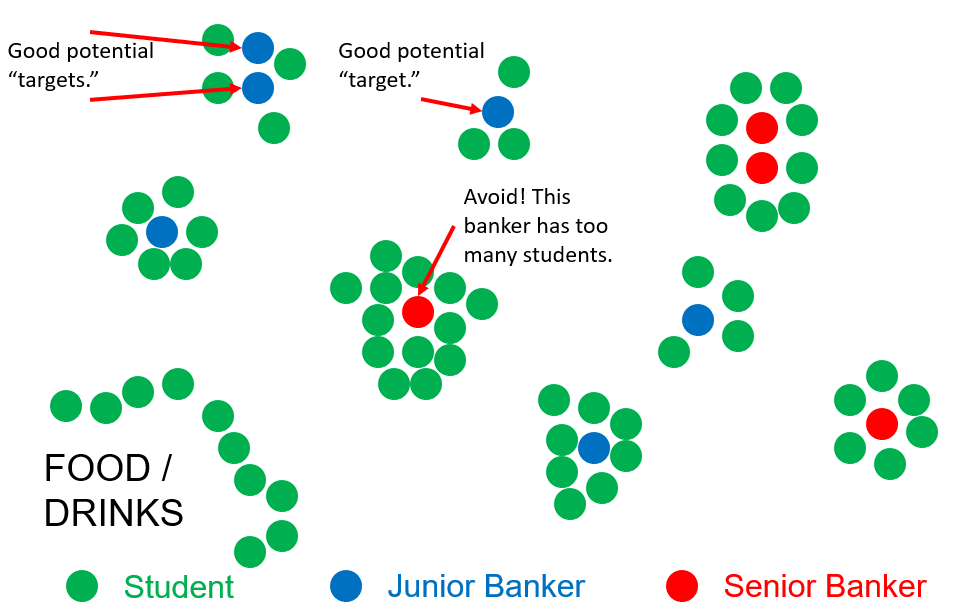
If the sessions are crowded with 10 students surrounding each banker, how do you make a good impression and use them effectively?

You don’t.

Ok, that’s an exaggeration.

Information sessions can be part of your strategy, but you should never rely on them. If you are in the position to use them, here’s how to do so without looking like Kenneth.

Why Most Information Sessions Resemble That Scene from Harold & Kumar

There are a few reasons why information sessions usually range from marginally helpful to completely useless:

  1. The obvious reasons – far too many students attend them, and it’s tough to get 1-on-1 time with any bankers.
  2. The barriers to entry are too low. Anything you can leverage that other people can’t gives you a big advantage when networking – but anyone can attend information sessions.
  3. There are many ways to screw up but very few ways to genuinely impress the bankers there (credit to Management Consulted for this point).
  4. Informational sessions occur late in the recruiting process, right before a resume drop – at that stage it’s hard to spend time developing new relationships, so you can’t gain much of an advantage.

This is not to say that you shouldn’t go to any sessions. It’s just that you shouldn’t focus on them – and you need to spend most of your time networking outside the sessions, even if those efforts start with contacts you made at the sessions.

But They Must Be Helpful for Someone, Right?

2 groups, in particular, have the most to gain from information sessions:

  1. “Early starters” – anyone in his or her 1st or 2nd year at the university level who still has time to develop relationships. This concept is less relevant at the MBA level.
  2. Anyone going to a “non-target school” – somewhere banks don’t recruit at – who attends sessions at a more heavily-recruited school.

The first point should be intuitive: of all the relevant factors when breaking into investment banking (networking, resumes, interview skills), developing substantial relationships through networking helps you the most – by far.

With more time, you can develop deeper relationships and gain a much bigger advantage in recruiting.

On the second point, keep in mind what we said above: anything you do that others don’t automatically gives you an advantage. It’s not common for students to attend information sessions at other schools – so you can stand out quite a bit by doing so.

If the session is focused exclusively on alumni, you may draw some negative reactions – but if it’s big enough, you can usually find at least a few bankers who are receptive to your cause.

Even if you’re not in one of these 2 groups, though, you should still consider attending at least a few information sessions.

What to Get Out of Them

This one’s easy: contacts. Sure, there are other ancillary benefits – such as finding out more about the industry, seeing if it’s right for you or not, and making a good impression on anyone involved in recruiting at your school.

Those are all fine, but with the possible exception of the last one there are other ways to accomplish each one.

The advantage of information sessions is that you get to meet dozens of bankers in the span of a few hours – it’s like speed dating for jobs.

Just like speed dating, you won’t develop real relationships with everyone you meet – but efficiency-wise it’s hard to beat information sessions.

Rules of Engagement

So you’re networking your way into investment banking and have decided that you’ll go to at least a few information sessions as part of your recruiting strategy. You’re contacting alumni and acquaintances on your own and making lots of other networking efforts outside the sessions, but you figure it can’t hurt to check them out, right?

Sure – but you need to make the most of your time.

Recall what we said above about the ease of screwing up compared to the difficulty of impressing bankers – most of the guidelines below are more about not making mistakes rather than being a star.

1. Don’t Be Kenneth from Harold & Kumar

Don’t ask stupid questions that can be easily answered elsewhere. Make your discussion personal and specific to the background of the person you’re speaking with – stay away from “Where is the industry heading?” or “How do you like being an investment banker?” type questions.

Better questions: “What was your background before getting into banking?”; “You mentioned that you work in the Financial Sponsors group – have you worked on any of the big consolidation deals lately?”

The difference between a poor question and a good question lies in the specificity. To pull this off, you need to spend your time asking open-ended questions and listening to what they say.

2. Don’t Be Urkel, Either

By the same token, you don’t want to be so detailed in your questions that you scare them away.

People often get the idea that it’s good to ask questions like, “So do you provide both bank debt and mezzanine financing to your clients in addition to comprehensive M&A advisory services?”

Pretend you’re meeting a new friend – not that you’re reciting a laundry list of finance terms to your professor.

You should approach interviews the same way as well: go for the personal connection rather than reciting obscure technical concepts.

Yes, it’s good to do your homework and be knowledgeable about the industry – but it’s also good to come across as someone who bankers could stand to be around at 3 AM while fixing typos in a pitch book.

3. Get Business Cards from Everyone

Don’t spend too much time speaking with any one individual – maybe 5-10 minutes at most. Your goal is to make a good impression and come across as likable rather than just another guy/girl from Harold & Kumar.

Most importantly, make sure you get a business card and contact information from each person you speak to – there’s no point in going to information sessions unless you get this information and then act on it.

Focus on anyone who isn’t surrounded by 10 other students (if they exist).

4. Follow-Up Within the Next Few Days

This goes back to the point above on barriers to entry: it’s very easy to go to information sessions. What’s more difficult is following up with bankers you meet there and developing relationships.

From my own speeches and presentations, I know that typically less than 1% of event attendees ever bother to follow-up – even if they’ve made a connection and have direct access to someone who can answer many of their questions.

There is absolutely no point in going to information sessions unless you get business cards and then use them to start conversations with bankers.

5. If There Are 10 “Kenneth”‘s Surrounding a Banker, Don’t Hesitate to Jump in Anyway

So what do you do if there are 10 students surrounding one banker and no one else is free or there aren’t many representatives there?

Jump in anyway – with more interesting questions than anyone else is asking. Remember, most of the students there will not have read this article and are still in Harold & Kumar mode, wondering “what it’s like being an investment banker.”

If you’re bold and ask pointed but appropriate questions, you can stand out and shift the banker’s focus to you right away.

Think about most of the bankers there: they’ve just pulled an all-nighter, gotten off a flight, or dealt with some annoying, high-maintenance client. After the session, they’re about to go back to work for even more of that.

The last thing they want to hear is another “Kenneth” question – so take a bold approach and don’t be afraid to jump into a large group with a question that doesn’t inspire them to dive into an acid-coated shark tank.

They might just like your style.

Other Tips

There are tons of other small tips you could use in informational sessions: dress well (business attire – don’t look like you’re about to go to a concert or like you just got back from a funeral), gravitate toward alumni from your school (if the session features bankers from multiple schools), and don’t spend too much time on anyone you already know.

Combined with the points above, these will set you apart from all the “Kenneth”‘s out there.

Other Breeds of Information Sessions

The type of event covered here is just one breed of information session. Other sessions are more like job fairs, where you walk around and literally have first-round interviews on the spot; still other sessions only have a few representatives from each company and they’re more about exploring rather than breaking in.

The more specific the information session, the more helpful it is for you.

Here’s a real example from my own history:

Right after I returned from Asia several years ago, I attended the Boston Career Forum, an event focused on jobs and internships in Japan.

Since you had to be bilingual and had to have some experience in the region, the barriers to entry were high. And as one of the few Westerners there, I stood out even more.

As you’d expect, there were not as many opportunities as you’d find at a more general US-focused job fair – but the “conversion rate” from interviews to offers was much higher. I won multiple offers from a single weekend of work, even though I spoke with fewer than 10 banks/finance firms.

If you want to gain a real advantage in networking, you should seek out targeted opportunities like this one.

Further Reading

I did some research while writing this article and came to a sobering conclusion: like so many other areas of finance, there’s hardly anything online that’s both valuable and specific. I found some good discussions on message boards, but nothing comprehensive that went through all aspects of information sessions.

The closest resource I could find: Kevin from Management Consulted gives a good overview of consulting information sessions, and many of his insights apply to investment banking information sessions as well.

If you know of other helpful resources on this topic, please let me know or write about them in the comments below.

Breaking Out of Harold & Kumar Mode

If you follow everything here, you’ll be in a better position than 90% of information session attendees.

You don’t want to follow a “Jack Bauer” strategy for information sessions (torturing bankers to get an interview is not recommended), but you definitely don’t want to follow a Harold & Kumar strategy.

So use common sense, and please, no questions on “what it’s like being an investment banker.”


Break Into Investment Banking

The Banker BlueprintFree Access to Exclusive Content for Members Only!

Sign up for The Banker Blueprint today and enjoy:

  • Free Report: 37-page guide with the action plan you need to break into investment banking - how to tell your story, network, craft a winning resume, and dominate your interviews.
  • Exclusive emailed bonus material.
  • Free Banker Blueprint newsletter with more in-depth advice.
  • Unlimited access to all articles, videos, and advice - and free updates whenever new content is added to the site.

We respect your email privacy

Comments

Read below or add a comment...

218 Responses to “How to Break Out of “Harold & Kumar” Mode and Use Investment Banking Information Sessions to Break Into the Industry”
  1. Josh:

    But, what is it like being an investment banker :p

    Good post, I just wish there actually were information sessions within 200 miles of where I go to school. Any thoughts on what to do in a situation like that?

    • M&I:

      Agreed, Chloe is probably your best answer. Failing that, I’d recommend getting out there and traveling – yes it’s expensive but honestly nothing compares to face-to-face meetings… it’s an investment.

      You don’t need info sessions necessarily but I’d strongly recommend meeting in-person with as many bankers as you can.

  2. Some advice:

    Get Chloe to set up a wireless video feed to a target school and route it through the CTU proxy servers to filter out the stupid questions.

  3. Jennson:

    I haven’t been to a career fair in ages and agree with a lot of this. It would have helped a lot if I knew what I wanted when I graduated from undergrad.

    • M&I:

      Yeah, but hardly anyone knows that. I changed my mind about 10 times…

  4. engbanker:

    I’ve been to an information session at a uni before with ibanker alumini. I actually made a connection too with one guy, although thinking that they would be too busy and not want someone sending them annoying emails etc, I didn’t bother asking for a business card… Sounds like that was short sighted on my part.

    • M&I:

      Yeah you definitely want to get their contact information – sure, some bankers might not be receptive but others will be more helpful.

  5. jason:

    Who is the best to contact when trying to find an insider with possible knowledge of current or future job opportunties? What level are responisble for hiring new associate or analyst?
    Is the hiring responsiblity the task of the Associate, VP or MD? And, if so, how do I find the company’s directory or organizational map?

    • M&I:

      Uh, well no bank is going to publicly give that information unless they’re really small. But ultimately MDs make hiring decisions – but it’s also usually tougher to reach them without a connection or introduction. So I would start with contacting lower level people first and then try to move up based on that.

  6. Jackson 5:

    Here’s my “move” that I usually pull when talking with someone:

    After a few minutes of conversing – usually with other undergrads asking questions as well – I’ll tell the person that I have to go to class/work/meeting/etc. but I’d love to have a business card so I can email with further questions.

    Then, in the email, I let him/her know I was the one who had to leave early, which is probably more memorable than saying “I was the one who asked you about your daily routine…”

    Thoughts on this? It seems to have worked well and I’ve kept in contact with quite a few people from these sessions.

    • M&I:

      That’s a good strategy and I could definitely see how it would work well in info. sessions – anything that makes you stand out (in a good way) is good.

  7. jason:

    Is there one MD specific responsible for the new hires? Or do I have to contact the MD for each group. And if so, what groups are the relatively easy and the most difficult to get into?

    • M&I:

      Usually one MD in each group will handle hires… there is not one who’s responsible across the firm. Group difficulty is completely dependent on the bank and the group and changes very quickly so it’s hard to generalize.

  8. jason:

    If I already posess a master degree. should I try to seek an associate position or an analyst position?

    • M&I:

      Unless it’s an MBA, Analyst is more appropriate.

      • MA:

        hi – Just wanted to reply to your note on the MBA… I do posses an MBA + 3 years of corp finance experience, but my MBA is not from a top B-school – it has an international accreditation, but is from small private school that may not be known by recruiters.

        Do I have a chance to breaking in as an associate?

        • M&I:

          You have a chance but it will probably be tough to get into bulge bracket banks because you already have some experience and don’t have a top name.

  9. MLSE:

    I know you touched on corporate finance roles at fortune 500 companies in a previous post, but I wanted to ask my particular question in an active post.

    I was wondering if you think working in corp. finance preMBA is adequate experience to get into Ibanking post MBA. Just to clarify, when saying I work in corp. finance, I am not talking A/R, A/P, but more along the lines of developing our post-merger operational model, long term cashflow modelling, improving cash generation etc.

    Thanks..

  10. JH:

    Thanks to your interview guide, after today’s CS first round interview for SA, I got a callback to the final rounds, which happens to be tomorrow. I’ve heard different things about final round interviews. Some people say that it will be all behavorial fit questions, while others have told me it will be very technical. What should I expect?

    • M&I:

      Congrats on the interview. its hard to generalize because every place does it differently – some people continue getting technical questions while others are all fit. bottom line is I would be prepared for either scenario and more than any preparation, make sure you get enough sleep so you come across as personable… thats more important than technical questions.

    • Jackson 5:

      JH, I have first round with Credit Suisse on Monday. Care to share what some questions were?

  11. Roberts:

    Thank you for the article. I have a question for you. I live in New York City and I was thinking about attending an investment banking information session. But the problem is I don’t know when they are held and where. Can you please guide me on how I can attend a session? Thank you.

    • M&I:

      Are you still in school? This article was referring mostly to info. sessions held at universities / b-schools. If you’re already out, I would talk to some friends who are still in school or maybe call the recruiting offices directly and find out when info. sessions are held. I’m honestly not sure how many / (if any) info. sessions are held outside the university environment.

  12. Misshighnetworth:

    What is a good estimate of how much summer interns get paid?

  13. Sean:

    Hey I have been trying to prepare for my meetings next week in NY and will be downloading/listening to your podcasts while on the plane. I will be meeting with a few MD’s, consultants, and a banker….what’s your best advice? What sort of questions should I ask them? How much time do you think I should spend reviewing technical questions? Or do you think its advisable to have a good story of why I want to get into Banking/Trading instead? As always, I look forward to hearing your response.

    • M&I:

      Story is the most important part of any meeting / interview so focus on that. Be very casual and focus the questions on themselves rather than asking generic stuff about the industry / banking / consulting.

  14. Sean:

    To add to my comment before….These contacts are all people I have discovered through family and friends and have pretty good relationships with those people already. They know I am looking for a job but I told them that I wanted to meet with them just to talk for a bit and all of them were pretty open to that, and had their secretary set up a meeting (or set one up themselves). Please let me know what you think! PS Once I return I plan on purchasing the BIWS course :)

    • M&I:

      Yup advice would not change too much – be casual, and make sure you are doing 90% of the question-asking. Try to do some research on them beforehand so you can ask more targeted questions about their background and how they got to where they are now – google searches, linkedin, etc. should be able to tell you a lot as well.

  15. jim:

    Just think its worth pointing out that sometimes its worth spending a lot of time with one banker. I went to a BB networking event, got talking to an associate, spent about an hour chatting, had a few drinks and he ended up taking my name (and me friend who was with me) to give to HR to “watch out for”. Got invite to interview about 2 days after submitting an application online.

    Sometimes it works out. I went to about 6 others with no tangible benefit to me.

    • M&I:

      Yeah you have to read the situation… if you’re getting a good vibe, stay there, if not, move on.

  16. aaa:

    I went to an IB info session today. How surprised I was to see just how many people ask about “How’s it like being an i-banker?” and so on so thanks a lot for your post. And today I did learn a lot about the bank and its culture, but unfortunately they specifically said they will not consider sophomores for internships. Should I follow up any way?

    • M&I:

      Yup still follow-up anyway. Never take “no” for an answer (obviously don’t be annoying about it, but even if they say that, it’s still good to reach out to them now and form the relationships early).

  17. Question:

    hello,

    I just went to an info session the other day, and I followed up with an e-mail the next morning. Would it be appropriate to send them an e-mail after I’ve dropped my resume online?

    • M&I:

      Eh you could but personally I’d try to call them or set up an in-person meeting at this point.

  18. AA:

    Is it okay to walk in late to these kinds of sessions? Due to my class I will have to walk in 35-40 minutes late. Would this make a bad impression?

  19. Michael:

    You actually answered an email for me recently – thanks a lot for your help! I’ve been going to info sessions, getting business cards and trying to follow up a few days afterward. In the emails, I usually say something along the lines of “I asked about graduate students applying for a summer internship…” in order to remind them of who I was. Is that a good way to re-introduce yourself? I also usually ask another question or two in the email. If they don’t reply within a week, what’s the best way to follow up again? Specifically, I don’t want to be redundant by basically copying/pasting the original email but I still have the same questions. Would I reference the old email, or treat the new one as if it’s the first?

    • M&I:

      That’s fine. I would try via email once again and if still no response, try calling instead. You can just make a shorter version of the first email.

  20. DI:

    Hi Brian,

    For follow-up emails, what would one usually say? Basically just reiterating your interest in IB and whether summer internshps or whether FT analyst/associate roles are avail would be appropriate?

    What’s the mindset on follow up? I am just not sure what questions one should be asking…

    • M&I:

      If its after an info session I would just ask to set up a 10-15 minute call and then ask about interviews at the end.

  21. Rachel:

    Hi Brian,

    Should I spend time talking to HR and get their contact info as well? Do they make important decisions throughout the recruiting process? If so, what kind of questions should I ask them or not ask them?

    • M&I:

      I would not spend time talking to HR, they tend to be pretty useless. Always better to go to bankers directly.

  22. Runze:

    Hey Brian,

    What do you think is a good “bold” question to ask to get the banker’s attention if he/she is surrounded by wannabes? Should it be personal or business-related? Also do you think it is bad to hand them your resumes; if so, how would you make them remember you (only by following-up)?

    • M&I:

      Just say something like, “Are these guys all boring you with asking what it’s like to be a banker?” or something like that that pokes fun at the other people. I wouldn’t hand out your resume, just get their card and follow-up.

  23. Max:

    Just got back from an info session with a well-know global boutique bank. I go to the second best undergrad business school in the nation and I was shocked at how many asked “how many hours do you work……oh, but do you really need to?” Just absolutely ridiculous questions. I actually got one’s undivided attention in a group of about 10 students just by asking a good question. Thanks M&I, your awesome!

    • M&I:

      Yup most people are clueless, glad it worked out well

  24. Peter:

    Hi Brian,

    went to an info session today. I noticed MD was talking all night, so I got him a water which he was pretty thankful. Too many ppl were surrounding him, and asking about markets & modeling. I only asked him two simple questions like “how do you relax yourself after work?” which makes him feel a little surprised, but he answered me nicely. Got his business card, and i think i also got him noticed me.

    I already dropped my resume on their site, and the job application deadline is in about 3 days. At this stage, which way (email/call) should i follow up is more appropriate? and what should i ask for from him?(like asking for how to prep interview?)

    • M&I:

      I would just call and ask directly “Hey I’m that guy you met at ______, just applied to your firm, was wondering if you had any tips…”

  25. Andy:

    So I’m going to a networking session for BMO Capital Markets on Monday. I’ve never been to a networking session in my life (always thought they were pointless before). I seriously can’t think of any questions I would ask other totally unrelated things like sports and that sort of thing. Can you give me some examples of some GOOD questions to ask these guys?

    • M&I:

      Search for informational interviews on this site and look at the comments, look at The Networking Ninja Toolkit and samples there…

  26. green:

    Hi,

    I’m also attending the Boston Career Forum and I was wondering if you can give me any tips specific to that event. For example, I am extremely curious as to how you got around the language problem since most of the companies require at least business level Japanese(because I would say that my Japanese level would only be about conversational level). Also did you attend the event without participating in applying to the companies beforehand on the cfn website?

    And any other tips would be greatly appreciated! Thank you!

    • M&I:

      You can just go up to companies and drop off your resume / introduce yourself. For language issues, sometimes there are foreigners there or foreign companies… they can be better to approach if you’re not at the business level. But for most front-office work, you will be tested and most interviews will be conducted in the language, so unless you’re applying for non-IBD work such as trading or IT it’s not even worth attending.

  27. JD:

    Hey M%I,

    Thank you for the article. There is a Career Fair coming up at my college. I’m currently a sophomore and many of these firms are in finance (many are not in the i-banking sector). I’d like to learn more about them and build relationships with the employees.

    What types of questions do you think are acceptable for me to ask the employees, given that I am a sophomore and have limited knowledge of some of the industries and the firms?

    I will certainly get business cards and keep in touch after wards.

    Thanks a lot!

  28. Phil Atio:

    I don’t ever get what I was suppose to talk about with an i banker I meet at info session after I meet them. The only thought that goes through my head on this issue is are you going to gimme a job or what?
    I heard the saying take them to lunch, but what would I talk about at lunch, I’m naturally quiet so it would be more awkward than normal, or maybe not so, it would largely depend on the person but still I would think it awkward to take a complete stranger to lunch or yet worse to be on the receieving end of being asked by a student to go out to lunch for seemingly no reason. I think most students think the above and hence why it is 1% of them who follow up.

  29. Sophie:

    Hi brian,

    Again, thanks for your handy tips. I’m lucky enough to read this before going to the career talk yesterday, and I realized there were some people asking stupid questions really.

    By the way, I would like to know what should i say in the follow up email. As I got some MD business cards, should I simply send a Thank You email to let them remember me? I’m afraid I may be annoying if i ask questions straight away.

    Second, do you suggest me to arrange an informational interview with the people I met in career talk? As I’m flying back to the UK to study where all the career talks are held in my home countries, how can I be more efficient to follow up/build relationship with them if I can only use email as a source?

    Third, I know senior people are those controlling final decision, however, those recruitment people may be the first to screen our applications, should i also approach them so that at least they may select me from thousands of applications before it goes to the MD hand?

    Last, should i approach the MD or associate if I have limited time?

    Thank you~

    • M&I:

      There’s coverage of follow-up and info. interviews here: http://www.mergersandinquisitions.com/investment-banking-informational-interviews/

      Phone interviews are fine if you’re in the UK and in-person would require traveling, but you should consider weekend trips at some point. You can approach recruiters but they’re generally not helpful because they do not actually screen applications most of the time… analysts review CVs. Go for the MD with limited time.

      • Sophie:

        Thanks Brian, I’ve read that article before. The problem is..the MD/related person usually mentioned how they break into banking in the career talk, and after chatting with them I usually get some more information about them. In this situation that i get answers similar to what i get in informational interview/phone interview, but it’s hard to give them impression like what informational interview can give as there are always a bunch of people around them. any suggestion for the follow up email? Should I simply say thank you or send my request within a couple of days? e.g. interview possibility or ???

        And for the recruitment process, you mean normally recruiters don’t screen applications? Since I’m not from target school, I’m afraid I can’t go through the 1st round screening and so I quite concern who pick candidates in a very early stage. Thank you.

        • M&I:

          Request a time to chat with them when you follow-up and then do a normal info interview… that is how you can stand apart. Just do it quickly after the event.

          Sometimes recruiters look at applications but they rarely screen them, it’s mostly analysts themselves who pick.

  30. LarryHoover:

    Hey M&I – Brilliant site here, easily the most informative and best. Quick question for you folks. Graduated from US T50 with liberal arts degree – doing grad school at LSE doing Acc.&Fin., trying to break in for summer internships at some banks. I have no background, but should these courses I am taking now give me a decent background for the interview process come early next year? I realize it does not matter exactly what courses you take, but in my case it’s absolutely essential, as my finance acumen is few and far between. As a side note, I def. plan on picking up a copy of your interview guide.

    • M&I:

      Courses will be fine to gain the conceptual understanding, though you probably want to look at interview guides as well because courses tend to be academic and not focused on what they actually ask you in interviews.

  31. bloom:

    Do you have any comments on business card/information session etiquette in the UK (from the perspective of an American), or suggestions for where to look for this information? I thought getting business cards was standard practice but apparently, in the UK, it’s not?

    • M&I:

      I’ve never heard of that before, though I’m also not familiar with business customs in every country – I would just ask around and see how people actually get contact information and if they go through online lists or something rather than getting business cards.

  32. Branden:

    Brian,

    there is a UBS event tomorrow at Columbia that I fully intend on going to. I guess to further elaborate on what a previous board member had posted. He said his “move” was to speak for a couple minutes then say he had class/meeting/etc. And ask for a business card

    well I was wondering if this would e appropriate. I have an interview w/ a boutique bank next Tuesday night at their offices around 7 PM. Should I to sort of leverage myself and also make an impression say somethig to the effect of “unfortunately I actually have a meeting with a boutique bank or whatever right now so I must go, would it be possible to get your business card?”.

    Doo you think that would be okay? Or any recommendations on how to phrase it better? I hope you can get back to me soon! Haha, sorry for such last minute this just randomly dawned on me.

    • M&I:

      Don’t say it’s at a boutique bank – just say that you’re running off to an interview right now but you enjoyed speaking and hope to hear from them soon.

  33. yelv:

    Hi Brian,

    This is definitely a great article. I am from a target school, am a subscriber to your Financial Modeling program (which is impressively comprehensive and much more useful than our school OPIM courses) and has been a loyal reader of your posts.

    For information sessions, I definitely feel that some questions automatically “trigger” the bankers into a “pitching mode” and talk about things that they are good at (such as this deal or that deal…). However, could you provide a list of sample questions like that? Or sell the related portion of the Networking Ninja Toolkit separately, since most other materials (informational interviews etc.) don’t apply to my situation?

    Thanks a lot!

    • M&I:

      I’m not sure I really have a list of questions like that – there are some sample question lists in the networking program but I don’t separate it out like that. I think the main questions are asking about specific deals, growth initiatives / industry focus, and so on. Asking something about why their firm or why they went there would do the same.

      • yelv:

        Thanks! Is there any source to read a compiled list of recent firm-specific deals, like what you would see in their marketing brochure? I’ve already known Deal Book, Reuters-Deals Today and Seeking Alpha-Wall Street Breakfast.

        In addition, what should I pay attention to when memorizing deals? How can I comment on them (in interviews)?

        Thanks a great deal!

        • M&I:

          Deal discussions are covered in the interview guide so you should follow what’s in there. I don’t know of any sources with recent firm-specific deals unless you have access to paid sources like Thomson or Capital IQ

  34. Rico:

    I am concerned about breaking into investment banking. My gpa is low, below a 3.0 although i am trying to get it up, but i am finishing college in 3 years with a finance degree. How low are my chances, and would staying an extra semester to double major increase my chances, even if my gpa doesn’t increase? Thanks…

    • M&I:

      Not really, GPA matters more than major or single vs. double major. With a 3.0 GPA you will need to network like crazy to get in and focus on smaller firms.

  35. Joe:

    I just got back from an information session. In the elevator afterwards I overheard a guy complaining about how a banker shut him down for asking “What do you do on a daily basis?” I laughed and remembered this post. It’s true; never overestimate the competition.

    • M&I:

      Yup you can show people all the tricks, but only 1% will ever implement them effectively.

  36. Michelle:

    Dear Brian,
    Thank you for this great site! I am wondering if you can post some content about the online application and the numerical and logical tests that followed here. I am really perplexed by the process. I think introduction on some skills and how HRs evaluate the online application will be welcomd by lots of people!

    • M&I:

      I’ve thought about it before but don’t know much personally so it would have to be a guest writer.

  37. D:

    I went to an information session (but more informal, since in my university and my country it’s not common) a week ago, on tuesday. It passed a lot of time (9 days) and I’m not sure how to write my follow-up e-mail to the guy who gave the talk (an MD). Should I apollogyze for taking so long to follow-up (i was with a lot of final projects), or should I just tell him about my intention to do a summer intership and to contact me with HR straight away? I now feel no excuse will be valid, but before reading your post I thought I had no hurry since interviews are on january-february.

    The good news is that I think he might remember me, since I was one of the few girls who attended and he asked me my name when I approached him after the talk to ask him what I should do to get an intership abroad (even though I know he forgot my name 5 min later haha). Another plus: he is an alumni.

    • M&I:

      Don’t apologize for anything, just follow-up and say it was good to meet him and ask for a quick time to chat to learn more about his background and recruiting at the firm.

      • D:

        He is in another country, plus I get nervous when calling, so I prefer to avoid that. Would it be ok to ask him how do I get into a summer intership and explain my situation (exchange student and J1 visa)?

        • M&I:

          You could but calling / meeting in-person are always more effective than email. If you get nervous practice calling less important people first until you get the hang of it.

  38. N:

    Hey M&I,

    I’m a sophomore at a target school. It’s end of November and I’m looking to land a finance/i-banking internship for this summer. I’m curious what the standard move is for a sophomore.

    I hear it’s extremely rare to get Summer Analyst offers at BB’s (since they prefer juniors). Would you suggest applying to one of these, or one of the few Sophomore Rotational Programs, or just try for a regional boutique bank? (I have zero finance experience)

    • M&I:

      Sophomore rotational program or regional boutique are the best options

  39. Jeff Lam:

    Hey M&I,

    I love your site and would like to translate some of the articles into Chinese and post them on my website (under construction), with the proper references/acknowledgement of course. Is this okay with you guys?

    Cheers, Jeff

  40. N:

    Hey M&I,

    I am a sophomore with strong legal experience but nothing related to finance. If I apply for a summer legal analyst position at a BB, could I then make a (more) smooth transition to I-banking for my junior year internship (since I would already be at a BB in an analyst role), rather than just going for a boutique I-banking internship this summer.

    Thanks!

    • M&I:

      I don’t think it would help that much since it’s legal, probably just better to go for a boutique

  41. Wendy:

    Dear Brian,
    I found contacts of some alumina who used to work for the bank I am interested in, or are working for the departments that I don’t want to break into. In this case, will it be wise to talk to them directly? OR should I ask for a referral? I can’t help saying: M&I is awesomelly helpful! Thanks!

    • M&I:

      You could still contact them – just bring up your interest in other areas at the end and ask for a referral.

  42. Dear Brian,

    I got into Baruch College (NYC) and London School of Economics recently. I know LSE has a bigger name in the world, but I have always leaned towards Wall Street. Which school do you think will provide me with the maximum chances to get into IB? Moreover, LSE costs a fortune, if compared to Baruch. Please help!

    Thanks.

    • M&I:

      Um, LSE, by a long-shot. Regardless of whether you’re in London or NY.

      • ‘Long-shot’ means ‘little chance’. Do you mean LSE’s brand name won’t affect much? Sorry for creating a confusion.

        • M&I:

          No, I meant “LSE is 1000x better” – yes it’s expensive, but you get what you pay for… access to recruiters is worth a lot.

          • Vivek:

            OK. Thanks a lot for the reply,

            Vivek.

  43. K:

    I flunked out ucla in the premed track. I want to get back to ucla through a special program. Do you think I can start from pre business econ and break into investment banking or is my life officially over?

    Should I go to community college first?

    What would be my chances of actually getting recruited to a bulge bracket company?

    • M&I:

      I don’t think your life is over, just re-start in business instead.

      • K:

        Up to what extent would my past grades affect my chances in getting into a large bulge bracket company?

        • K:

          Dear Brian,

          I know I sound naive and over-reaching, but what would be my chances on a company like Goldman Sachs.

          I mean, UCLA isn’t even a target school and I got dismissed from college. Would I be over looked during the recruitment season, even if I were to start over and started getting 4.0s in my business economics.

          I’m planning to work really hard this time and I know that I will do what ever it takes if there was any possibility that it would possible.

  44. HD:

    Hi Brian,

    Great info, thank you. I am not from IB background but currently pursuing part-time MBA from a reputed NYC school. I have more than 15 years of work experience. Do I stand any chance of getting into PE? If so, how could I start?

    Thanks

    • M&I:

      It would be pretty tough with that much experience, probably need to find a PE firm that has some type of industry focus complementary with your background.

  45. regan:

    After i completed my MBA pro gramme straight after my bachelor’s, will it get me a job as an associate, or will i have to start as an analyst in a Bulge Bracket?

  46. Ben:

    You briefly mentioned attending information sessions at schools other than your own. I go to a non-target (but still respected) school that’s in close proximity to ivy league and other target universities. My question is, how feasible is this option really?

    I feel like failing to mention I didn’t attend the host university would be dishonest and short-sighted. But I also can see how mentioning I snuck into the session from another school would cause them end their conversation with me (especially if they’re alumni of the host university).

    I guess the only positive outcome would be if they thought it was bad-ass that I snuck in but this seems less likely.

    • M&I:

      While it’s uncommon I’ve seen it work well before, so no reason to avoid doing it. Some bankers will not appreciate it but that’s true of almost anything you do. Don’t say you “snuck in” just say that you are from another school and were visiting today for something else and decided to drop in on this session.

  47. Timo:

    Hello

    I realy need help in chosing the best option.

    I’m 22 year old student from Latvia, i’m currently finishing my bachelors degree in international economic relations and i want to do investment banking in the future. I read books about investing and trading, i’m also trading forex. I have already had 4 month internship in DnB NORD bank, it’s a Norvegian commercial bank.

    So here is the dilemma.
    I have just been accepted by International Travel Network (INT) as a sales agent, they provide full training and after that i’ll start working full time.

    Yesterday i’ve got an invitation for an interview from Pricewaterhousecoopers for Assistant position. Also another audit company KMPG invited me for an interview for the same position.
    These are just invitations and i’ll have to complete tests in english and logics which will not guarantee that i will get an offer.
    Which experience will provide the best opportunity to break into IB? should i turn down ITNs offer and go for audit? but if i fail to pass the tests i’ll lose everything (i’m quite confident that i can do good, but still…) Or should i stick to sales for 1-2 years? will it be a benefit for breaking in to IB?

    Thank you

    Artjom

    • M&I:

      Answered on another thread keep interviewing with the Big 4 firms and if you get those drop the sales job

  48. Solomon Hailu:

    Would you consider the University of Virginia a top school?

    • M&I:

      The business school there is a target for banks but not sure about the university at large

  49. Tariq:

    Stupid question but when you attended the Boston career Forum, did you know Japanese? Would I be able to get in with basic Japanese or do I need to be proficient?

    • M&I:

      You need to be at least conversational for IT and trading-type positions, and fluent / extremely good at reading/writing for IB and PE-type positions.

  50. Jenny:

    Hi Brian! I am totally lost as to what I should do to break into investment banking. Please help me out.
    I am an 20-years-old international student studying Communications at UC Davis. I am Chinese from Hong Kong. My current GPA is 3.5. As an international student, it is extremely hard to find an internship because I can work at most 20 hours per week on my student visa(sounds unattractive to employers). And the jobs on campus are mostly taken by students who are either Hispanic/Black or low-income students.
    I am very lost but I still have a strong desire to be an investment banker. I know Finance because my parents have taught me how to analyze different financial products since I was very young. However, since I am a Communication major, it is hard for me to show that I know how to do the job, let alone impress anyone with a resume drop.
    So what should I do now? Should I get a Masters degree in Accounting to rebrand myself? Or should I keep networking like a ninja? Or should I quit thinking about being a i-banker and do something else?

    Many many thanks,
    Jenny

    • M&I:

      Best option is to get a Master’s degree at a better school. You could keep networking but it might actually take less time to apply and get into a top school for a Master’s program.

Comment Rules: Thanks for contributing to the discussion - we really appreciate your comments and questions.

Criticism is fine, but if you're rude, try to impersonate someone else, or attack others, then we'll delete your stuff.

Please do not ask questions about the CFA or GPA rounding, as these have been answered elsewhere on the site many times.

Have fun, and thanks for adding to the conversation!

Share Your Thoughts: