The Complete Guide to Cold Calling Your Way Into Investment Banking
Internship recruiting is over.
And you made a valiant effort, securing 10 interviews with everyone from boutiques to bulge bracket banks – but you didn’t land the offer.
And now you only have a few months before your non-existent summer internship begins.
With recruiting finished, your last, best chance of breaking in is to cold call your way into Wall Street.
But will that even work?
Should you bother going all-out and calling hundreds of firms?
And if you do take the leap, how do you cold call your way in successfully without getting slapped with a restraining order for being too aggressive?
Does Cold Calling Really Work?
This is the most common question about cold calling:
“I’ve tried calling 10 different banks and no one is hiring! I sent my resume to all of them, but I haven’t gotten any responses! What is going on, does cold calling even work? Why are you lying to me?!!!!”
The answer is yes, cold calling does work – but it does not work instantly.
If you don’t believe me, take a look at all these stories from readers who cold called and cold emailed until they got in.
Cold calling and cold emailing work better:
- In developed markets like the US and UK.
- If you’re an undergraduate or recent graduate.
- At tiny boutique banks/PE firms/hedge funds.
It’s questionable in regions like Asia, parts of continental Europe, and Australia – I’ve seen mixed results there, whereas there are dozens of success stories from the US/UK.
That’s because recruiting is more traditional in those places and randomly contacting people is not as accepted socially. So give it a shot, but make sure you pursue other options if you’re in a region where it’s not as effective.
It also won’t work as well if you’re at the MBA level or you have full-time experience because you should be leveraging your network to break in instead.
I’m sure some people have cold called their way into bulge bracket banks and mega-funds, but it’s rare and I don’t recommend spending much time on it – those firms never have trouble finding qualified, bright-eyed, and bushy-tailed interns.
And finally, once again: do not expect instant results.
Cold calling is an extended and ego-bruising process where you’ll get bankers yelling at you, writing nasty emails, and acting like Gordon Gekko when he first met Bud Fox.
And unlike Bud, you can’t use insider information to work your way in.
…But Why I’m Still Not a Fan
So cold calling works – but I am still not a huge fan because:
- It can easily turn into a repetitive grind where you spend hours each day calling random banks.
- Networking is much more effective if you do it via referrals and informational interviews.
- Cold approaches are more effective in-person at events like information sessions where you can get the other person to remember you more easily.
- The odds are stacked against you because you have little to offer to banks as a student.
But, you could easily find yourself cold calling anyway if:
- You go to a non-target school where no banks recruit and you have no connections.
- You’ve exhausted all your connections and still haven’t found an internship.
- You can’t make it to in-person events and you live far away from major financial centers.
And remember: all it takes is one.
What Exactly is a “Cold Call”?
What is a “cold call” and how is it different from other types of networking?
The main difference is that you don’t know the other person – unlike contacting alumni for informational interviews, you are randomly calling them and have no previous interactions or connections with them.
You are also much more direct – rather than chit-chatting about their background and asking about what they do for fun outside of work, you ask about internships and recruiting right away.
And if you don’t get a positive response, you persist until you do, you try again later, or you move on to other banks on your list.
On a standard cold call, you might introduce yourself in 1-2 sentences, ask how you can position yourself for an interview at the firm, and then respond to the other person’s “objections” (we’re not hiring anyone, we don’t have the money, etc.) until you get a real answer.
It’s the difference between dating and randomly hitting on people at a bar in search of a one-night stand.
How to Cold Call Like a Champ
It’s a 5-step process:
- Get a list of banks or bankers in your area with their names and contact information.
- Plan your pitch and figure out what you’re going to tell them.
- Place the call and be prepared to respond to their objections.
- Afterward, follow-up at least once a week until they tell you to stop calling.
- Meanwhile, continue to contact and follow-up with other firms on your list.
Timing is extremely important.
You do not want to start cold calling places when it’s still the middle of recruiting season – you should be using other means like weekend trips, informational interviews, and information sessions to contact bankers.
It may seem counter-intuitive to postpone cold calling until the last-minute, but it makes sense for a number of reasons:
- You can focus on your higher probability options first and only spend time cold calling if nothing else works out.
- If you wait until the last-minute, you can find banks that really need interns.
You don’t have to do this – I’m sure some have succeeded by cold calling during recruiting season, but most successful readers started late in the process.
Getting Names
There are a couple ways to do this; the best method is to get Capital IQ access from someone who has it and search for local boutiques in your area.
Failing that, there are over 13,000 firms in the Investment Banking Networking Toolkit and other sources online with names and contact information for firms.
You could also try random Google searches, LinkedIn and even using tools like Google Maps to get names – it really depends on how much time you have left and what your deadline for finding an internship is.
If you live in the middle of nowhere and there are no firms in your area, get your butt out of your chair and hit the road.
Contact firms at the financial center closest to you and make it clear that you’re willing to move there right away.
Refining Your List
One other quick note: no matter how good your source is, do not just blindly call numbers.
Always search online first to verify that the place still exists, that’s it what your list says it is, and spend a few minutes learning something about what they do, recent deals, and so on.
No matter how comprehensive the data, things change every day and unless you’re willing to pay tens of thousands of dollars, it’s impossible to get everything updated in real-time.
Planning Your Pitch
This is the easiest part of the entire process. The main mistakes to avoid:
- Giving your life story rather than a 1-2 sentence introduction.
- Not getting to the point and chit-chatting too much.
So don’t do either of those.
Instead, plan a 1-2 sentence introduction where you say something like, “I know you’re busy so I won’t take too much of your time – I’m a [Major] student at [University Name] and I’ve worked at [Company Names] before. I wanted to see how I could best position myself for an internship at your firm.”
That’s it – this is not rocket science.
Placing the Calls
You do not want to fumble around and say “um” or “ah” too much on the actual calls. You will get better with practice, so I recommend “warming up” with places you don’t care about as much.
Say the same thing to everyone to minimize screw-ups.
Ideally, you will call the bankers directly (higher level is better if you can find them – MDs have more power than VPs, VPs have more power than Associates/Analysts) and speak with someone who has a say in the hiring process.
But more often than not, you will only have their main number – you can still recite the same script, but you need to be prepared for the gatekeeper to respond with their objections and keep you locked out.
Calling vs. Emailing – Cold Emails For the Win?
Right about now, you might be thinking:
“If it’s so hard to successfully get through when cold calling, why not use email instead? Does cold emailing work and is it more effective than cold calling?”
Personally, I am biased against email – but that might just be because I get hundreds of emails each day and can’t even respond personally to 90% of them.
Emails are easy for bankers to ignore or delete, whereas phone calls are harder to dodge. And catching them in-person, of course, is even harder for them to avoid.
But you may still have better luck with cold emailing, especially if you’re not good on the phone.
I’ve seen it go both ways, so you have to experiment and see what works for you. If you do cold email bankers, attach your resume/CV and ask directly in the email how to position yourself for an internship there.
What to Expect on the Calls
Ok, back to calling now – what should you expect when you call and pitch the banker or the gatekeeper?
95% of the time you will get variants of the following response:
“We’re not hiring.” / “We don’t recruit interns.” / “We don’t offer internships.”
Do not give up when they say this or you will never succeed.
Respond by saying, “So you’re in charge of all recruiting for the firm?” or something to that effect – if it’s a gatekeeper they will say no, at which point you then ask to be put in touch with the person who is.
Other strategies for getting past this initial rejection:
- Ask for a banker by name and fib a little by saying you were scheduled to call him/her and ask how you could be put through to talk to him/her (and if you get voicemail, hang up, call back, say you were disconnected, and ask for the number).
- Avoid closed-ended questions (“Do you have any internships?” / “Do you recruit interns?”) with a few exceptions (such as the one about the person being in-charge of all hiring).
Closed-ended questions lead to quick rejections because the person will always respond with “No”; “how” questions are better because you assume that they already offer internships and it’s just a matter of how you will get what they’re offering.
Handling Objections
Even when you make it through and speak with a real banker, you’ll run into other objections:
- “We already have someone for the summer.”
- “What value could you add to our firm?”
- “We can’t afford summer interns.”
So you need to be prepared with a response for each of these:
- “Really? So when your deal flow picks up and your hiring needs change for the summer, how could I position myself for an interview so I could help you out?”
- “There are plenty of tasks that you need help with and your time is best spent winning clients – let me handle everything else.”
- “I understand that money can be an issue, so I’m willing to work at below-market rates – and you get a great deal anyway since this is only a trial and I’ll save you more money than I’ll cost you.”
You don’t want to offer up too much at first (e.g. immediately offer to work for free) as that makes you seem desperate; reserve that for when they continue to object.
Persistence vs. Stalking
I’ve gotten a lot of questions on “how far is too far?” and the difference between being persistent vs. turning into a stalker.
You should feel uncomfortable cold calling if you’re doing it correctly.
Unless you have a lot of experience in sales or randomly approaching people, this entire process will be new and uncomfortable to you.
If you think you’re going “too far,” you’re probably not – the only tactics I would consider too extreme are:
- Showing up at the bank’s offices in-person and demanding to be let in (even if you’re not carrying an AK-47 this will result in bad things happening to you).
- Finding out where the bankers live, camping out in their bushes, and then jumping out to pitch them when they arrive at home.
- Calling every day even after they tell you “No” explicitly and warn you to stop calling them.
You know it’s time to move on when they say “No” without even giving a specific reason why – that means they are really not interested and probably can’t be persuaded otherwise.
The first lesson in sales is that an objection is the first sign of a prospect’s interest, and it’s the same idea here: no specific objections, no interest.
I’m sure someone will now leave a comment saying that my advice is crazy and will get you in trouble or result in you getting “blacklisted” (even though nothing like that even exists).
But you are not doing anything unethical as long as you stick to simple calls and emails, so it’s not as if you’re lying about your offer status and forging documents to win interviews/offers.
Expect that some bankers will not like your tactics and will be extremely nasty to you.
On the other hand, some bankers will admire you for having the guts to cold call them and hustle your way into Wall Street.
Even though I satirize bankers here with the “Stuff Investment Bankers Like” series, they do not, in fact, all have the same personality and so their responses will vary.
If you get a negative or sarcastic response, do not take it personally – the banker might just be having a bad day or might be a tool to begin with.
You need a thick skin or you’ll never make it in the cold calling game.
Following Up
So you’ve cold called several places and gotten lukewarm responses – they already have people for the summer, they don’t have formal internships, or they can’t afford interns.
Rather than giving up, follow-up at least once per week until they tell you, “No” definitively and tell you to stop calling. Many readers have been successful with extremely aggressive follow-up.
You can also email to follow-up and mix up your approach a bit, but I still prefer calls since they’re harder to dodge.
Your follow-up should not be much different – use the same script and just say you’re following up to reiterate your interest and see what has changed since the last time you spoke.
How Long Before You Succeed?
I can’t give you a definitive answer because it’s random – some readers have succeeded in only a few weeks, whereas it has taken others months of networking to land offers.
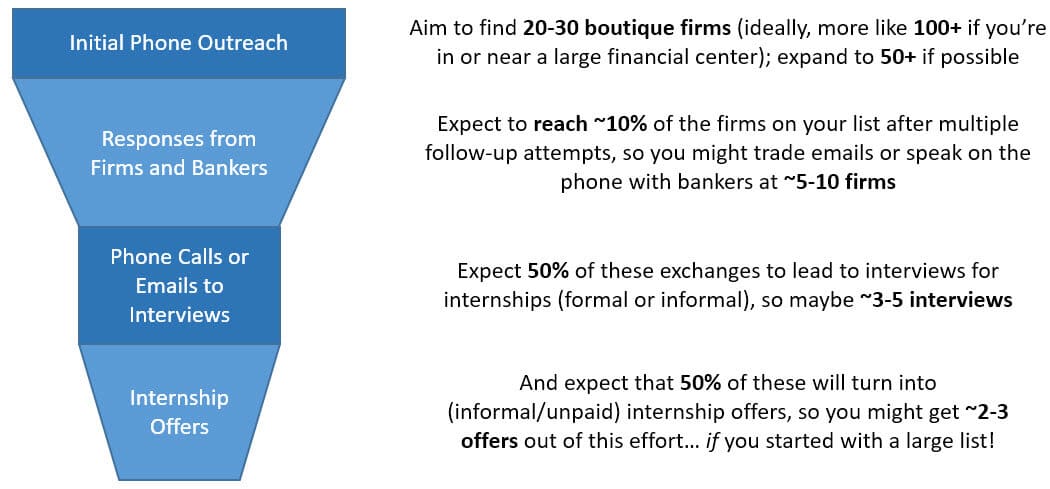
But you should not expect solid results until you’ve called upwards of 100 firms and followed up with all of them.
That is a lot of cold calling, so you should still pursue “Plan B” options for the summer such as internships at normal companies, private wealth management, and so on.
It took Sylvester Stallone 1500 rejections to star in the first Rocky movie – so please do not complain until you’ve reached at least that number.
This Sounds Really Hard!
At first it is and you will be very intimidated when you cold call MDs at banks. But it gets easier with time and practice, and after a while you barely have to think about it – sort of like interviews and walking through your resume.
I’ve lived in dozens of cities and have “started over” with 0 friends and 0 connections multiple times, so I’m more aggressive than most when it comes to meeting people and showing up uninvited at events – and randomly approaching people is still hard for me.
I still fail and get “rejected” a lot, plenty of what I do leads to failure, and I’d say that less than 10% of my attempts actually result in good stories / good friends afterward.
But it does get easier and less scary with practice – and the good news for you is that the phone tends to be less intimidating than approaching random people in-person.
Next Steps & Further Reading
So, what now?
Get started making your list and placing those calls.
Do not succumb to analysis paralysis and make a flow chart showing every possible response in your planned conversation and what you’ll say next – get a handle on the basics but don’t obsess.
If you want further preparation, check out these case studies, podcasts and other resources:
- How to Break in as an Engineer with No Finance Background – Cold called 120 banks
- From Non-Target and Unpaid Wealth Management Internship to Bulge Bracket Bank – Email better than calling?
- How to Break Into Private Equity Straight Out of Undergraduate – Cold called 50 equity research analysts
- How to Get Into Investment Banking from an Unknown State School – Kept calling, calling, and calling until he got in
- How to Break Into Investment Banking If You Have a 3.0 GPA, Went to an Unknown School, and Only Recently Learned English
- How to Turn Cold Calls Warm – Podcast
- The Investment Banking Networking Toolkit
And now get to work pounding the pavement until you break in.
Break Into Investment Banking
Free Access to Exclusive Content for Members Only!
Sign up for The Banker Blueprint today and enjoy:
- Free Report: 37-page guide with the action plan you need to break into investment banking - how to tell your story, network, craft a winning resume, and dominate your interviews.
- Exclusive emailed bonus material.
- Free Banker Blueprint newsletter with more in-depth advice.
- Unlimited access to all articles, videos, and advice - and free updates whenever new content is added to the site.


Great article and nice timing, now I have a few more lines to use in my calls.
Glad to hear it.
Hi,
Great article Brian ! I have been cold-calling boutiques over the past 2 weeks with very little success. I have contacted over 20 firms and most of their responses have been “just submit your resume online in our website careers section and we will get back to you if an opening arises”. Although you had mentioned in the article on some of the approaches to the other objections how do you think I can get around this obstacle and perhaps make them more receptive towards my approach.
Thanks in advance
Tell them you understand that but wanted to find out more about the position and firm first directly from them.
I’ve had significant success with both networking and cold calling in Australia, although for the latter it often wasn’t properly cold (I had a connection* that while he couldn’t take me on was very helpful and as such that I could often open with XXXX (At YYY said you were looking an analyst…)
*The MD in charge of a friends bussiness
** Forgot to mention this has only really been with small boutiques. Anyone with a significant graduate program seems pretty entrenched with the normal recruitment system.
Interesting to hear that – I’ve heard the opposite before but guess it goes both ways.
Hi Michael,
I’m starting my way with networking towards investment banking in Australia but haven’t had much success. Would you mind sending me a PM giving me some pointers as to how you did it? I would really appreciate it.
Thanks Ivan
Email: ivanyan8@hotmail.com
Brian,
You mention that the blacklist is a myth. How about individual firms?
I’m a sophomore now. Will cold calling every boutique on your networking ninja list this year hurt my chances of getting an internship this year (god forbid I don’t get a bulge bracket hah
It seems to have cut me off.
–assuming I do everything moderately to well and don’t break into banker’s homes.
Thanks,
Lowell
I would not worry about it, turnover is so high that the people will probably be different anyway and even if they’re the same they won’t remember every detail of what you did as long as you don’t go overboard.
Hey Brian,
I have been putting a list together over the past few weeks and recently began my networking ninja training. Since I don’t have CapIQ access, I thought toolkit’s list of banks would suffice, but I noticed a handful of the Chicago banks aren’t around any more and also some well known firms don’t show up anywhere (i.e. KeyBanc Capital Markets). How often do those lists get updated?
Thanks!
They were updated a few months ago so should be fairly recent. But it is dependent on other data sources so it will never be perfect.
Large well-known banks are purposely excluded because cold calling would not work well there anyway – only banks headquartered in a specific location are included there because the idea is to focus on small boutiques.
This method would work for a 2-3 month pre-MBA internships as well? Is having an unpaid pre-MBA banking(or long/short hedge fund) internship useful when it comes to full-time MBA recruiting?
Yes potentially, though cold calling tends to not work as well at that level. Unpaid pre-MBA internships are still incredibly useful: http://www.mergersandinquisitions.com/business-school-rebranding/
Hello Brian! This was a great read/review—I’m on the retail side of a BB firm, and have successfuly networked/met with our IB and AM teams (Asset Mang/Funds Mang) in NYC several times using many of these tactics and JUST GOT AN OFFER—BUT—it’s in AM as an Internal Client Advisor in Funds Management supporting Wholesalers selling Mutual Funds and Managed Accounts to big wirehouses+regional firms. My dilemma: Should I take this (be in NYC) perform as best as I can, then try to exit into S&T in our IB later (Ultitmatly want to Sell/Trade Mortgage Backed Securittes) or keep pushing and trying to land in S&T instead?
Personally I would take it and then leverage it to move into S&T/IB as it’s easier to move in from a non-retail role anyway.
If I were to further my knowledge of M&A subsequently to my pursuit of MBS S&T, would a course like IBI be helpful, or is it a waste of money/time? Why would your course be better?
One more Q: I had great meetings that ran almost 3 hours (was noly supposed to be 15 mins but kept being introduced to more and more ppl!) with S&T guys on my last NYC trip in my BB firm—problem is finding a role to match—-what approach do you suggest I take with recruiters; Summer Internship? Unique placement solution? Sales Assistant?
Thanks again for all that you do for us!
Well, the courses here you can take any time, always refer back to, ask questions whenever you want whereas you don’t get that with live training. And the price point is orders of magnitude lower.
But if you want to do S&T there is no point in doing any of these modeling courses as there is no modeling like that in S&T – it’s 100% different and not covered by courses.
I would go for sales assistant if you’re already working full-time, internship won’t work well at that stage
Hey Brian,
Would facebook ad marketing be a good strategy to land an IB analyst position? Original and clever, but not professional.
Ex. “Your future Investment Banking Analyst” with a link to your personal website.
Thanks,
Rob
Personally I would not do that as a) Finance is 10-20 years behind the rest of the world with tech/trends/hiring practices. b) It could easily turn into something that gets passed around and written about on sites like Dealbreaker that ends up ruining your life and forcing you to change your name/identity.
Brian, do you think cold calling will be effective for accelerated interviews at the end of summer? Or should I contact HR instead? I’ll be interning in a regional office (prestigious BB and i’m the only SA in IBD) but may want to work in NYC after graduation. Asking my superiors isn’t such a good idea because they want me to work in that office in the future, so it has to be a secret mission. Thanks!
It can be, but contacting HR is a good bet anyway. Only cold call if HR is unresponsive or you can’t get through.
Brian, will you do a Mining modeling course soon? I know you have O&G already and a RE course coming up, but I would definitely like to see a mining modeling course as other fellow readers would as well.
Mining will not be a separate course because it is 90% overlap with Oil & Gas, so it will be add-on lessons to that. Since O&G was released at the end of 2010, mining will probably not be out until the end of 2011.
Dear Brian,
Amazing article! And would you please offer some advice to me? My current company is firing and I want to ask my ex-boss (MD level) for a job. (Know the idea is silly but I have solid reasons). It apprears to be a mission impossible because: (1) I lied about where I was going to work when I quit my previous job and my ex-boss later found out. (2) I don’t want to trouble any former colleagues to help out, just to avoid gossip. (3) Since ex-boss is constantly on traval, in-person meeting or even stalking him is difficult. Reasons why I still want to try: (1) I used to be a star performer at my previous firm; (2) my ex-boss sort of liked me (I am a girl so no gay).
How do you think I should approach this???!!!
Thank you!!
Sorry I’m not sure I understand your question – if you’re asking how to ask your former boss for a job when you’ve already lied to him and he found out about it, I don’t think you have much of a shot. All you can really do there is call him if you still have is number, say specifically what you’re looking for and ask “Just wanted to see how you could help me to…” or something to that effect.
Thank you Brian… Yes I don’t think I have much of a shot either. I’ve already screwed things up, but I don’t think it’s going to be worse.
One more question, in the article you said when you cold call someone, your pitch should be like “I can offer help”. Can you explain why in my case I should say “‘how you could help me to…’ or something to that effect?” Do I sound a little bit desperate? Guess you may want to write another article about “call a MD you’ve pissed off for a job”…
Many thanks!
In that situation it doesn’t really apply because you’re not offering anything to the MD – you’re just asking for his help. So I wouldn’t apply the same strategy if you’re just getting a referral.
Brian, thanks for this timely article. I have been cold-emailing lately, and some boutiques say they’re not hiring due to their small size. I know the “never take no for an answer” thing, but if they’re actually not hiring, what do you suggest I should say in my reply to their email?
Just follow-up with them in a few weeks and say you’re checking to see what has changed and how you might be able to help them out and contribute over the summer.
do you think taking a loan for 70 K, MS finance at a non target school is worth it? I’m currently unemployed, for the last two years. I was working at a botique asset management in the back office, trying to make the transition to IB. I’m considering going to school to brush up on my studies, but what are your thoughts?
Really depends on what your other options are – $70K is a lot but if you’ve already networked exhaustively and have been out of work for awhile then the MSF program could be a good idea.
Hey Brian,
Thanks for all your help. I’m a senior non-finance major and just pulled a boutique interview off a cold call. I interview tomorrow. He mentioned the dress at the firm was casual and that he wears khaki pants and a dress shirt to work. He said no one in the office wears suits, but did not explicitly say I should not wear a suit.
I’m thinking, okay, I take this opportunity very seriously, I’m wearing a suit. Or, if I show up in a suit, will he think I’m an asshole and don’t listen?
Thanks,
Rob
Always wear a suit to IB interviews.
Hey Brian,
Thanks for the articles, they have been really informative. I have a couple questions about the process though.
Is it too late to start now? I know any firm with a program for recruiting is probably out of the question, but I was settling for a boutique anyways.
I notice some of the boutique firm’s websites tend to list their entire team’s phone numbers. If cold calling leads nowhere with one MD, should I consider trying with another in the same firm?
Thanks
Yes most firms are done with recruiting now (April). Some boutiques are not, though, and even at some BBs people drop out at the last minute and so on.
And yes, you should definitely try other people even if 1 MD at the firm is unresponsive.
Thanks for the reply.
This is my situation. I’m currently a junior at a semi-target in Canada going for my econ degree. I only recently decided on pursuing a career in finance however I am worried that my lack of relevant work experience and bad GPA from my first year are going to make this extremely difficult.
My initial plan was to get some relevant experience starting this summer by interning for a boutique firm, but I don’t know if they’ll even consider me. Should I be upfront about interning for a firm this late in the game, or should I cut my losses and work on them for the long term?
Also, I read your article on plan b’s and was wondering if I can’t get an internship in IB does the cold-calling process apply for PWM and Corporate Finance internships? If so, how strict are the requirements for these positions and would your Networking Ninja toolkit have a list of firms that have these departments?
PS: when cold-calling is there a rule of thumb as to how formal one should be? By that I mean should I be addressing the MDs as Mr. so and so, or is their first name just fine?
You could still try going for an internship as some places may still be hiring. Yes cold calling still applies for PWM and corporate finance, the networking program does not have those firms because it is more focused on IB/PE/HF though a few of the hedge funds may be sort of like asset management.
I would not say Mr., just use their first name if you are in a Western country.
Thanks again Brian,
I actually just signed up for your free finance model tutorial (which has been really great so far).
I was wondering how much prior knowledge about a firm should I know before making contact?
Thanks
I would spend maybe 10-15 minutes reading up on them and looking for recent deals/activity before contacting them.
Great article!
Question might be a tad unrelated but I graduated 2 years ago from an Ivy majoring in Economics. I never did any finance internships, instead taking classes one summer (I graduated early) and working on a research grant I won in Cognitive Science. Do you think its too late to try to land an analyst position? Would I even qualify for internships at this point? I’m still very sharp with my corporate finance/investments courses and try to keep up with markets, I tutor friends for the GMAT. Basically I know I could kick ass but realize I’m at a huge disadvantage not interning in college. Any advice?
If you graduated 2 years ago your chances are extremely low but you could try cold calling… no one would take you for an internship. You would have to find a bank that has exact overlap with your background (e.g. if they do healthcare and you have some kind of history or work experience there).
Hi Brian,
Thank you for this blog. Could you please help me if this profile is good enough for an Associate (Corporate advisory) with 1 yr experience at a boutique?
myjobs.shine.com/Job-Search/Finance-Accounts-Tax-Banking-Insurance-Financial-Services-Job-Description/Associate-Strategy/261190.aspx
Thanks,
Josh
Hard to say from that description and not really sure what you’re asking – that is a job posting, are you asking about your own profile?
My questions was how good is that profile whose Job Description is given in the job posting. I am planning a switch now and my CV has been shortlisted for the profile mentioned. Called up the HR. She said the profile directly reports to the MD and would involve assisting him in evaluating potential deals, preparing ppts for board presentations, monthly MIS for the status of various deals in execution under the MD’s team. In this org., the execution team is entirely different. I wont be doing execution at all. Help needed.
It depends on where you’re coming from and where you want to go. If you’re not doing much real work at your boutique (if I understand this correctly and you are an associate at a boutique?), then yes, it may be a good idea assuming that bank is larger or better-known than your current one.
But it sounds like a 100% marketing job, so that part is not good and you won’t learn too much if you don’t do any execution. So I would only take it if you are not doing much real work currently and this other firm is much bigger.
Thanks for your reply. It is also a boutique ibank of a group which has a VC fund, Wealth Management Grp., and Corporate Finance division. They tell me I could be a VP (Business Development) in 2-3 years given my performance. In India, many ibanks have a separate business development team, and the execution team comes to play only when a mandate is received.
Brian,
Do you think you could elaborate on cold calling for during the school-year Fall internships? I am working at an MM this summer in a regional office, but would like to get more experience during the school year and possible internship credit.
Just call them during the school year and ask how you can position yourself for a school-year (or say fall spring etc.) internship there. Go through the advice recommended above and say you know they may need help even when it’s not the summer and position it as a “trial” or something part-time so they see it as less of a commitment on their part.
Hey Brian,
I finally decided to start the process earlier today and managed to contact around 6 firms and I was hoping for your opinion on certain things I’ve encountered.
Firstly, I decided to contact firms at around 4:30 (as per your recommendation), which I found to be decently effective, however I was finding that around half of my contacts/potential referrals were already out of the office. Would you advise against starting earlier in the day, such as at 3 or 4pm?
Secondly, I found that my calls tended to get me shuffled around to find the “right people” as my contacts were not responsible for recruiting. I wasn’t sure whether or not to interpret this as them turfing me to HR. Is there anyway to make it clear that I’m looking to speak to whoever has decision making power in the hiring process?
Thirdly, would you recommend leaving voicemails? Is there any chance that a banker will get back to you through by these means or is it better to just try again the next day or until you get them in person? Also would you follow up with said person if you had already left a voicemail? or would that be perceived as “annoying”?
Lastly, one objection I encountered that was not mentioned was “I’m sorry, I don’t really know if we are hiring interns and I wouldn’t know who to speak with regarding to that.” How would you approach this situation?
I’m trying to make it a habit to follow up every call with a real person I’ve made with an e-mail thanking them for their time and I’ve tried to mention something that we’ve talked about or that I’ve read about them. Is this overkill?
Sorry for all the questions but I value your opinion highly and I definitely would not be here without your website.
Thanks.
1. You can start earlier if you find they are gone too early.
2. Yes, just say, “Could you please put me in touch with the investment banker who interviews people / who makes hiring decisions?”
3. In general, no – I would only leave a voicemail if you cannot get through after 5-10 tries.
4. Say, “Thanks – could you please put me through to the banker who’s hired others at your firm at all levels in the past?”
5. It’s overkill for cold calls.
What do you say if people respond with something like “we are too small to have interns” or “we used to have interns but we don’t anymore”
“So if the economy continues to improve and your deal flow and work requirements pick up this summer, how many interns would you hire?” or “I understand, but I’m sure there are plenty of tasks that senior bankers need help with – their time is best spent on winning clients, and I could save them time on everything else.”
I have just graduated last year and struggling to find an internship/graduate position. I don’t have a finance degree and I am from a non-target school. When I ask for interships during cold-calls, do you think that I should lie to bankers that “I am planning to study Master of Finance in LSE (for example) some time in the future, can you give me a pre-finance internship?” or should I just say that I am a recent graduate without finance experience who want to get an internship because I cannot get full time offers?
If you really are planning to do a Master’s degree in the future, just say that but don’t give a specific school name unless you’ve been accepted.
Thank you for your valuable insights. I really enjoyed reading your articles. Can you give me some tips on the counter attack on the following objections?
1) We are a very small firm. We do not have a proper internship programme.
2) Why don’t you try applying to the large banks?
3) The gatekeeper: The director will not pick up random calls. Tell me your name and your company and I will pass the message to the director.
4) There is not enough desk space for an intern.
1) “So you’re saying that there’s nothing at all that you need help with?”
2) “I’m more interested in smaller firms where you’re closer to the deals.”
3) “I actually had a call scheduled with him from before, he might have forgotten to write it down” / “Could you just put me through so I can leave a voicemail?” (then hang up, say you got disconnected, and call back and ask for his number) / Call before or after the gatekeeper arrives
4) Say you don’t need a desk or could work from anywhere with a bit of free space in the office and will supply your own computer.
Hi Brian,
Thanks for this insightful article. I really look to intern
at a PE/Venture Capital firm and have found one in China starting early August. But now I am facing some unexpected VISA issue and may not make it there. So do you think it is too late to cold call local firms (I’m in Chicago) to ask for an immediate position now? Shall I tell them my situation?
Thanks!
You could still ask but getting pretty late at this point, worth a shot to try though. Don’t explain full situation, just pretend as if you’ve gotten interested and are looking for something right now.
look familiar?
http://www.insidebuzz.co.uk/how-to-cold-call-your-way-into-investment-banking.html
Haven’t read the article before. Thanks for sending through the link
When cold-calling, is it best to speak with an associate or an MD? I know MDs clearly have more power but aren’t the associates more hands on?
Any thoughts?
MDs. If you’re cold calling anyway, you might as well call VP level and above. Associates have a vague idea of what MDs will do but always call the person who has the hiring power. You never know
Love this site! I hoped I had found it when I tried to look for internship in IB. I’m looking to follow up with internship whether summer internship or placement to breakthrough Europe or US market. Since networking in person is not quite the option for me. What do you think the chances of cold call working for an undergraduate from a target Asian university with experience in brand name internship from Asia Bank?
Tough given visa requirement and the economy. I may be wrong. You can always try.
Hey,
I’ve been cold calling and emailing and very few people have gotten back to me.
Is it acceptable to just walk up to those offices and ask to speak with someone or is that frowned upon?
I live really close to all these offices and I walk by them everyday so I figured, what’s the worst that can happen? Yes or no?
Any thoughts?
Personally I would not go in-person as it can come across the wrong way. Maybe try it once and see what the reaction is, but that would normally be considered too aggressive. You just have to be super-persistent calling.
Brian, just a quick question.
I currently have an internship offer from a bulge bracket and am looking for another internship to fill my time until that one starts. When cold-calling / emailing should I mention my offer to make me seem more desirable, or would it deter them?
Thanks!
Sam
Yes mentioning the offer will make you more desirable as long as you can still fit the other internship in and there are no conflicts of interest.
Hi Brian, I’m freshman and am currently applying for so-called spring programmes in London which are offered from many banks. I cold-emailed an investment banker who’s working in London (im Swiss) and he came up and called me today. I was quite nervous at the beginning and the call had last for over one hour. But from these 60 minutes I approximately talked just 20 min, so he was very much speaking. But at the end he offered me to send my resume to people he knows in the respective banks, despite I thought that the call was horribly bad. So how do you interprete this? Would you recommend to cut ones sentence off to let you speak? Because I think he was so much and fast talking that it would have been very unfriendly/stupid to interrupt him. Thanks!
If he has spoken with you for 40 mins after you spoke for 20 mins (since the call lasted for over an hour), I believe you’ve probably done a relatively good job in impressing him. He wouldn’t have spent so much time w you otherwise (unless he really is that bored in the office). No. Its always nice to listen while others speak. When you listen and give others your attention, you show others that you are very interested in what they do and who they are, in turn they like you more. If you cut people off, you might appear “rude” and “insensitive.” I would follow-up with him the same day I spoke with him. If you haven’t already done so, please do so (short, brief email thanking him for his time, insights and advice. Then say – as discussed in our conversation earlier, I would appreciate it if you could please forward my resume over to people you know in other banks (as a gentle reminder)” Be assertive but don’t be rude, offensive or annoying
Hi Nicole. He informed me last week that he had forwarded my CV to one of his friends and he said, he would soon ask his other friends (at other banks) too. Since then (last Thursday) he didn’t say anything. Should I follow up or wait until next week?
Thanks
Follow-up this week if he hasn’t responded by Wed.
I found an alumni’s info, however I’m unable to get in contact with that person (no one picks up the phone and there in no email address listed). You advised to not drop by there office uninvited, but I plan to stop by there office and drop off a letter for this alumni…Is this a good idea?
Sure.
Could you offer some advice on cold emailing
1. What are some of things you say in the email?
2. Do you attach your resume and cover letter?
1. Make it very short and state your name, where you work / go to school, 1 sentence on why you’re qualified and then what you’re looking for.
2. I would just attach your resume when cold emailing since the email is effectively your “cover letter” (unless they ask for one separately).
Thanks for your help.
I’m a freshman looking for an internship-probably pwm. I’m not sure what to say my qualifications are since I’ve never had an internship. Should I approach it more as I’m very interested in learning or should i talk about my 4.0 1st semester and acheivements in high school and college? Thanks again.
Both. You are a freshman so I don’t think people would expect you to have any internship experience. However, you should demonstrate your willingness to learn and stellar grades
Hi Brian
I can not stress enough how useful your articles have been, so thanks! My question is:
Once the banker has shown some interest (in that he asks me to send him my CV), when exactly should I follow up. And how should I follow up: phone? email? And what should I say exactly…I was thinking “Have you had a chance to look at my CV” type of thing.
Thank You for everything!
Reda
Follow up by email. When? A few days after your last contact with him. What to say? Tell him you are really appreciative of his help, and ask if he has had a chance to look at your CV.
Be persistent but don’t be a hassle!
Hi Brian,
Just wanted to get your advice. I’m 29 and have been out of school for about 5 years. I have a finance degree from a non target school, and since graduation have been working at trading firms as a junior trader. I want to get into investment banking, and have even taken the investment banking institute course. Is it still possible for me to break into banking as an analyst? I’ve read all your articles and made a pretty decent list of alumni in banking in Chicago. Would you suggest moving forward contacting them as well as cold calling boutiques still?
Yes contact and cold-call them. Networking will improve your chances significantly
What about if they just say send my resume and they’ll pass it along if there’s something that comes up? Should I still push to get together or for a call? I feel like just sending my resume doesn’t really do much
Try to ask them for coffee and offer to drop by their office to make it easier for them
Hi Brian
Great read, thanks. I have a very specific question and case: I worked as a junior research analyst almost 10 years ago for two years – that is my problem – I have been so long out of the industry. Reason: change in career path, travel, and four kids later. During my pure motherhood period, I decided I wanted to get back into finance, so completed the CFA (might as well do something to update my skills, given i was home with the kids). Finished it in 2011, in 3 years. How can someone like me possibly get back into finance? How can i pitch a cold call? My resume looks horrendous with such a large gap from when I last worked in the industry, with English teaching my last work (with the kids, it was convenient). Any ideas/suggestions would be greatly appreciated!
Cheers
Good question Lisa. I think you taking the CFA was a good idea in your case. You can just tell them that you took time off since you were starting a family. I think it might be best to try boutiques/second tier firms/independent research houses/firms with an emphasis on “women development” to increase your chances. If you can try to get an internship in the meantime that may also increase your chances. I’d also gather a database of research analysts in the sector you followed and/or are interested in and contact them
Thanks for the advice Nicole. One more question, in terms of resume, what approach would be better? Stating my relevant experience, albeit 10 years ago, up front, or writing ah um, english teacher, as current? Does it look ridiculous to write up first a job I did 10 years ago?
Thanks again
Hey Brian,
I’ve been frequenting this site for ages and really appreciate all the contributions! I am a graduate (graduated in 2009) from a non-target school, majoring in finance (3.4+ GPA). When I graduated, I moved with a friend to start a cloud computing company, however it never really took off. Currently, I am a financial advisor with Merrill Lynch. I have been in this role for a full year now and I’m not happy with the position, although I have been very successful so far in the training program (it’s a 3 year program). I have always wanted to work in investment banking, but I think I’ve short changed myself by not applying. How can I position myself for a move into IB/PE in NYC and what are my odds? I don’t really have any interships except for one summer I spent doing accounting research.
Thanks! Hm, before you apply for IB/PE, I think you should figure out:
1. Why are you not happy w the position?
2. Do you prefer an entrepreneurial or corporate work environment?
3. Why do you want to work in IB/PE?
4. How can you add value to IB/PE?
Figure out 1-4 first. You can then craft your pitch and position yourself!
Hi,
Loved the inputs, thanks for sharing.
I would want to start cold calling, I think I can overcome the fear.
Which companies do you think I should cold call?
Would it be appropriate to cold call MDs at GS, JPM, Morgan Stanley or Citi for example?
I’m getting the impression that cold calling is more appropriate for hedge funds and prop trading companies or companies that don’t have the “Career” sections on their websites.
What is your opinion?
Btw, I’m trying to find my way in S&T rather than IBD… cold calling is still appropriate?
Yes cold-calling is still appropriate for S&T roles
You can still cold-call MDs at BB esp if they are alums or you have some sort of connection w them, though cold-calling might work better w smaller firms.
Hey Brian and team,
I am the guy who wrote about working on the M&A Case Competition as distinguishing myself in terms of recruiting. As an update, I wanted to thank you for the cold calling guide as I can attest to success it does have. I began cold calling firms in the fall and with less than a month of spring semester left, I was able to land 2 IB Middle Market Offers both from initial cold calls. It was this approach that impressed the people that I spoke with, so I would also agree call > email. That said, persistence and not giving up, even after multiple rejections, was the key.
So thanks again for all your advice and great site.
Hey John,
Can you say a little bit more on your experience?
Who did you contact? MDs, VPs, Analysts?
What was the conversation like?
Were you direct with them that you need a job?
What kind of rejection did you get? what do you mean by this?
I’m cold emailing, and I have a lot of success… I’ve spoken with about 6 people in the past 3-4 weeks. It works as well but I’m not sure how to bring the job thing to them and how to keep in touch with them.
Would really like to hear about your strategy.
I’m also cold calling HR people, but it’s not something useful.
Thanks!
As for my experience, I currently work for a VC in a school year internship and previously worked at a BB last summer in their Finance Division (scholarship opportunity, as well, which I grateful to get). As for contacting people at firms, I would other sites such as Wall Street Oasis to get a list of firms in my region and made an excel sheet of those firms with a column in sheet for who I contacted. I would always start with MD and then go down the chain. The MD can influence the process most. I would get their contact info and get my pitch to work on. The conversation a lot of times was along the lines of the objections Brian highlighted above. Interestingly, for one of offers, I was able to turn the conversation when I said I would be interested in intern opportunity (was looking for full time at that time). Make sure in pitch to be direct along the lines of “How can I best position myself for a internship at your firm.” A good tip I found worked was to call after cold emailing your resume, so that way you are taking the initiative of following up as if you already established a connection. In fact, this lead to person I spoke with that eventually gave me an offer to say how impressed she was since most people do not follow up to a cold email. The conversation would for some calls turn into a phone screen, so always be ready to interview and know why banking and why that firm. As for rejections, I got all kinds from ones and I even realized early enough it was my story after I was cut off telling it in one interview. Fixed my story (This really is key as Brian mentioned) and it was pretty good from there. I would say with the people you contacted that you should say something along the lines I mentioned earlier and see whether an opportunity could be there or not, because you do not want to waste their time and yours. I also got a PE offer at local shop, but that was through different means. I ended choosing the place that give me great experience and exposure to PE, as they have a PE division. Also was able to be paid for role (Interestingly, I called the other bank that gave me offer (unpaid) and she told me she would willingly to see If I could be paid and told to keep in contact for a possible opportunity in the fall).
So it is all about persistence and being diligent. I know how horrible it feels to be rejected for some many places from different stages of interviewing or not receiving an interview at all. Just remember to keep at it until you have the offer in hand (in my case, email and phone call). Also, as Nicole told someone, you have to visualize yourself being an investment banker and this will help your demeanor moreso. Good luck and reach out if you have any other questions or need tips.
Hey John,
Thanks very much for the reply, appreciate it.
So, I see you are not trying to build relationships but you are being straight with them that you need a job.
I understand that you are attaching you resume to the cold email. The way I go is that I email people and ask for career advice. Few get back (out of 30-40 emails, about 6-7 got back).
Do you think it worked better for you with smaller companies?
I will give it a try with small companies next week… hope to have success… will let you know…
Thanks a bunch and I wish you great success!
Your cold email is cover letter with the resume attached. The M&I Cover Letter is where you would turn for this. Make sure you reach out to MDs first. At this point, being direct will yield more results. Also make sure you are hedged with applying to other roles finance related.
Thanks for your comment.
Thank you for your feedback – We greatly appreciate it! :)
Loved the article. Here’s my situation: Rising senior currently with a wealth management internship at a BB. Not for me so I want to look for something part time for the fall during school. To do so, would it be best to 1) Cold call regional boutiques (I have a huge list I got from a friend with Capital IQ) 2) Or use LinkedIn to message alumni from my school to “ask for advice”, etc. I assume from everything you said that building relationships (such as reaching out to alumni) is better but maybe cold calling would benefit me more for the fall? Thanks.
I think both works. Good luck!
I’m going to become an undergrad soon (non-target), but I was in the progress planning how I would try to break into IB. Of course, I came across this article.
I noticed that the article mentioned that cold calling should be a last resort. However surely it would be effective if I employed that method alongside other methods rather than leave it to last? Or am I missing something here?
Yes it would still be effective.
At the end of a cold call, is it ok to ask bankers to review my application for a internship and consider me as a canidate, the first time i speak to them.
Sure if the cold call goes well
Brian,
I was wondering if there were any resources one could use to find local boutique banks in the area to reach out to for an internship/co-op. I am an Electrical Engineer attempting to break into IB with a strong GPA, but am probably not as qualified as others due to my lack of financial experience (I’ve had a finance-related internship, but nothing banking).
I’d suggest you to research online for the banks. Or you can check out http://breakingintowallstreet.com/biws/. Our Networking Toolkit should provide you the resources you need
Brian,
I was wondering if the timing and techniques would work the same for someone looking for a job. I’ll grad. in May and I’m looking to get an analyst position.
Thanks for everything.
Yes.
Brian,
I am a lower level Junior applying to equity research and investment banking internships. I go to a NYC semi-target (think Fordham/Baruch) and have a 3.6 GPA, but other than that my resume is honestly not impressive. My EC’s are non-existent and my only work experience is cold calling for a credit card processing company summer of freshman year. I’ve been cold calling/emailing like crazy and don’t seem to ever have any luck. Do you think I should just focus on PWM and other internships I have a realistic possibility of getting, just for the sake of putting something decent on my resume, or do I have any sort of realistic possibility of even landing a MM investment banking internship with no prior internships?
I would still continue to contact a few banks here and there, but probably focus more on boutiques. And then overall focus more on PWM and related internships, and then leverage those to get into ER or IM afterward.
Thanks for the help.
Hi! I’ve called 20 banks already and I’ve never, ever spoken with a banker, always the secretary. They always say either: “we don’t take interns” or “just email us”.
I’m absolutely clueless about how to get past that. I tried your recommended responses and nothing. I don’t know what I’m doing wrong.
Could you give me some advice please?
In that case, I would try contacting bankers directly by looking them up on LinkedIn and using that instead. You need to somehow get a banker’s real number… so maybe the best approach is to search around online first to find that, or get their numbers via a service like Factset or Capital IQ.
I’m planning on cold emailing some BBs and MMs for an un-paid PWM internship and was wondering how a sample cold email would look like? What content should I include in it? Also, I hear I should email the brokers or financial advisors, but I can’t seem to able to find contact info other than regional managers of PWM. Should I also attach resume or no? For reference, I’m a high school graduate, taking a gap year and going to target school.
Please see http://www.mergersandinquisitions.com/networking-investment-banking-jobs/
Attaching a resume would help.
Hi,
Thanks for another great article !! I have 3 questions about cold calling.
PS: I am interested in hedge funds, not investment banking.
1. Does cold calling / emailing work for hedge funds too?
2. In one of your podcasts (which Brian conducted together with ManagementConsulted.com), you suggest to cold call instead of cold email. But given that the person we are contacting does not know us AT ALL, would he not be VERY AWKWARD getting a random call from a complete stranger? I would assume that it is better to email him first, so he can read the mail at his convenience (and also, he knows SOMETHING about you when you call)and THEN call him to follow up. What would you suggest – cold call or cold email (or cold email FOLLOWED by cold call)?
3. You recommend that when we are cold calling, we mention where we got the person’s contact details. I signed up for one of your paid networking tutorial sessions, and received contact details of some funds. But I feel awkward saying “I got your contact info from an online forum’s networking tutorial”. (I feel that this will make me come across as a spammer). What would you suggest?
Many Thanks!!
Rahul Dravid